
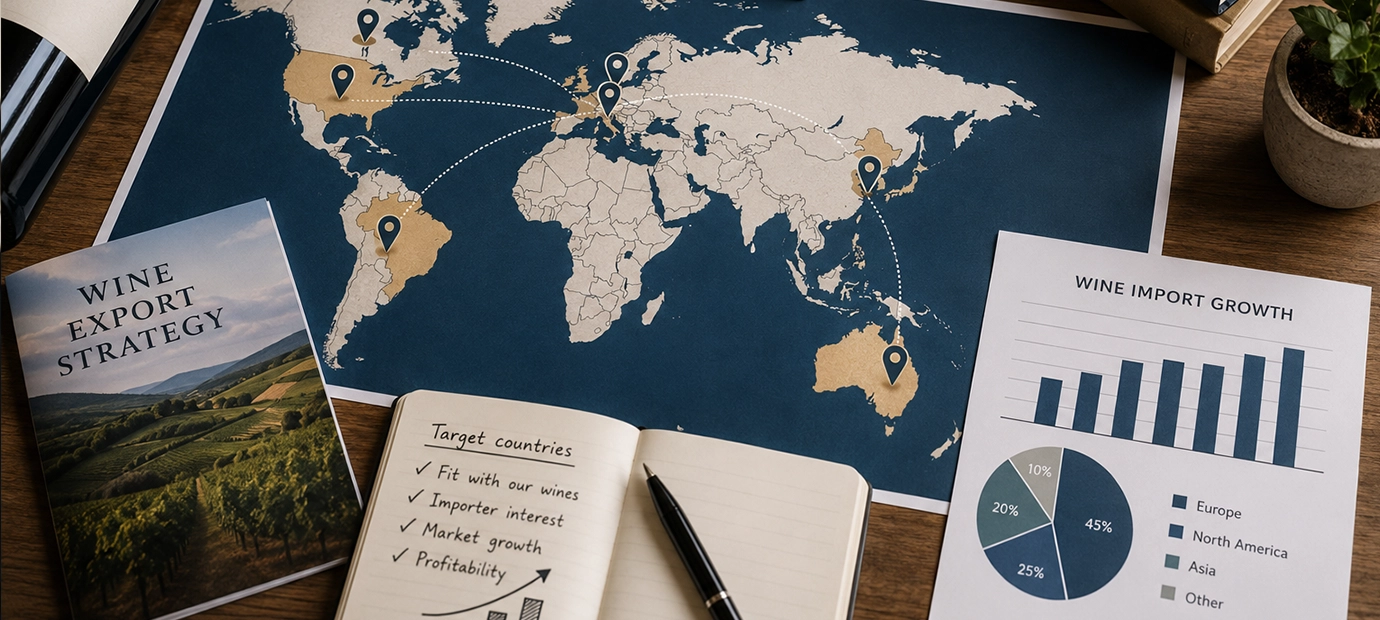
For wineries looking to grow internationally, one of the first questions is often: “Which countries should we target?”
It is a simple question, but the answer is rarely simple. A large market is not always the best market. A country with high wine consumption may also be highly competitive. A smaller market may offer better opportunities if local importers are looking for new origins, niche producers or specific wine styles.
Many producers begin their export search by looking for wine importers in as many countries as possible. They collect lists, send emails and wait for replies. Sometimes this approach brings results, but very often it leads to wasted time, poor-fit contacts and no clear strategy.
A better approach is to choose export markets carefully before contacting importers. The goal is not to be present everywhere. The goal is to identify the countries where your wines have the best chance of finding the right buyers, the right sales channels and the right commercial conditions.
Wine importer guides by country
Explore our 38 market guides to compare importer business models, sales channels and the practical steps involved in approaching buyers. Start with the countries that fit your pricing, available volume and commercial resources, then use the market-selection framework below to narrow your shortlist.
Western and Central Europe
- Germany wine importer guide
- United Kingdom wine importer guide
- Ireland wine importer guide
- France wine importer guide
- Netherlands wine importer guide
- Belgium wine importer guide
- Luxembourg wine importer guide
- Switzerland wine importer guide
- Austria wine importer guide
- Portugal wine importer guide
Nordic and Baltic markets
- Denmark wine importer guide
- Sweden wine importer guide
- Norway wine importer guide
- Finland wine importer guide
- Iceland wine importer guide
- Estonia wine importer guide
- Lithuania wine importer guide
Central and Southeastern Europe
- Poland wine importer guide
- Czech Republic wine importer guide
- Hungary wine importer guide
- Romania wine importer guide
- Bulgaria wine importer guide
- Slovenia wine importer guide
The Americas
- United States wine importer guide
- Canada wine importer guide
- Mexico wine importer guide
- Brazil wine importer guide
- Colombia wine importer guide
Asia
- Japan wine importer guide
- South Korea wine importer guide
- China wine importer guide
- Hong Kong wine importer guide
- Taiwan wine importer guide
- India wine importer guide
- Singapore wine importer guide
- Thailand wine importer guide
- Vietnam wine importer guide
- Malaysia wine importer guide
Each market needs its own buyer qualification and pricing assessment. Regional proximity or a distributor’s presence in several countries does not establish import rights, customer coverage or a suitable partner in every territory. The Mexico and Iceland guides also cover beer and spirits.
Start with your winery, not with the country
Before looking at foreign markets, producers should first look at their own offer. A winery’s export potential depends not only on demand abroad, but also on how well the product fits a specific market.
A small family winery with limited production, premium positioning and a strong story will not need the same markets as a larger producer focused on volume, competitive pricing or private label. A natural wine producer will usually look for different importers than a winery selling classic appellation wines. A sparkling wine producer may need markets with strong demand for celebrations, hospitality and premium retail. An organic or biodynamic winery may perform better in countries where consumers and importers already understand these categories.
This is why choosing export markets should begin with a clear view of your own profile. What is your price range? How much volume can you offer? Are your wines entry-level, mid-range, premium or luxury? Do you have certifications? Are your labels and packaging adapted for international markets? Do you already export, or are you entering foreign markets for the first time?
Once these questions are clear, it becomes much easier to understand which countries and importers are worth prioritizing.
Do not choose markets only by size
Large wine import markets are attractive because they offer more buyers, more consumption and more potential sales. Countries such as Germany, the United States, the United Kingdom, the Netherlands, Canada or Japan are often high on the list for many exporters. These markets can be excellent opportunities, but they are also competitive.
Large markets usually attract many producers from many countries. Importers receive constant offers, shelves are crowded, margins can be tight and buyers may already have strong supplier relationships. Entering these markets requires preparation, a clear positioning and a good understanding of what makes your wines different.
Smaller markets, on the other hand, should not be ignored. Countries with lower overall consumption can still be interesting if they have strong importer networks, a growing premium segment, demand for new origins or a good fit for your product category. In some cases, a smaller market can be easier to approach because importers are more open to discovering new producers.
The size of the market matters, but it should never be the only factor. For wineries, the best market is not necessarily the biggest. It is the market where your wines can realistically find buyers and build repeat sales.
Look at market maturity
Some wine markets are mature, with established consumption habits, experienced importers and sophisticated buyers. These countries can be excellent for producers with strong positioning, clear quality and reliable export structures. However, mature markets are often selective. Buyers know what they want, and they may compare your offer with many alternatives.
Other markets are still developing. They may have growing interest in wine, a younger consumer base or increasing demand from restaurants, hotels and specialty retailers. These markets can offer opportunities, especially for producers willing to invest time in education and long-term relationship building.
Mature markets may be better for wineries that already have export experience and professional sales materials. Emerging markets may be interesting for producers that are flexible, patient and able to support importers with storytelling, training and marketing content.
Neither option is automatically better. The important thing is to match the market’s level of development with your winery’s resources and expectations.
Understand local sales channels
Wine is not sold the same way in every country. In some markets, supermarkets and large retailers dominate. In others, restaurants, hotels, independent shops, online platforms or specialized importers play a bigger role.
This matters because your ideal importer depends on where your wines should be sold.
If your wines are premium and require explanation, you may need importers with strong relationships in restaurants, fine wine shops and sommelier networks. If your wines are competitively priced and suitable for larger volumes, retail-focused importers or distributors may be more relevant. If your brand has strong visual identity and consumer appeal, online wine retailers and specialist shops may be important. If you are targeting hotels and hospitality, you need partners who already sell into that channel.
Before choosing a country, try to understand how wine reaches the final buyer there. A market may look attractive on paper, but if the main sales channels do not match your product, it may be difficult to build results.
Evaluate competition and positioning
Every market has competition, but the type of competition can vary significantly.
In some countries, buyers may already be very familiar with your origin. This can be helpful because your region or category does not need to be explained from zero. At the same time, it can also mean that many similar wines are already available, and you need a strong reason for importers to consider another producer.
In other countries, your origin may be less known. This can create an opportunity if importers are looking for something new, but it can also require more education. Buyers may ask why consumers should choose your wine instead of a more familiar alternative.
The key question is not only whether your category exists in the market. It is whether there is room for your specific positioning.
A producer should look at the existing offer, price levels, competing origins, importer portfolios and consumer trends. If your wine is too similar to what is already widely available, you need a clear advantage. If your wine is very different, you need an importer capable of explaining and selling that difference.
Consider price and margin expectations
Price is one of the most important factors in export market selection. A wine that works well in one country may be too expensive or too cheap for another, depending on taxes, transport costs, importer margins, retailer margins and consumer expectations.
Producers should understand how their ex-cellar price translates into a final shelf price or restaurant price in the target country. A wine that seems well priced at the winery may become difficult to sell after duties, logistics, margins and local taxes are added.
This is especially important for small and medium wineries. If your wines are positioned in a premium segment, you need markets where consumers and trade buyers are willing to pay for that level. If your wines are more commercial, you need markets where your price remains competitive after all costs.
Importers will quickly evaluate whether your pricing makes sense for their market. If the numbers do not work, even a good wine may not lead to a deal.
Think about logistics and regulations
Exporting wine involves more than finding buyers. Each market has practical requirements that can affect your decision.
Some countries are relatively straightforward from a logistics and documentation point of view. Others require specific labels, registrations, certificates, local agents, monopoly systems or more complex import procedures. These requirements can add cost and time, especially for smaller producers.
This does not mean difficult markets should be avoided. Some of them can be very profitable. But producers should understand the process before committing resources.
If entering a market requires label changes, special documentation or significant administrative effort, you should be confident that the commercial opportunity is strong enough to justify it. For a first export campaign, it may be better to begin with markets where the process is more manageable and importers are used to working with producers like yours.
Look at importer availability
Even if a country looks attractive, the real opportunity depends on the importers available in that market.
A good export market should have importers that match your winery’s profile. If you produce organic wines, are there importers focused on organic or sustainable portfolios? If you produce premium wines, are there companies selling to restaurants and specialist retailers? If you produce large volumes, are there importers with access to retail or wholesale channels?
This is where many producers make a mistake. They choose a country first and only later discover that the available importers are not a good fit. A better method is to evaluate the importer landscape before committing to a market.
Look at how many relevant companies exist, what type of portfolios they manage, whether they work with wines from your region or category, and whether they appear active. A country with fewer but highly relevant importers may be more attractive than a country with many companies but little fit.
Prioritize markets instead of trying everything
Trying to approach too many countries at once usually leads to weak results. Each market requires research, adapted communication, follow-up and patience. If a winery spreads its efforts too thin, it becomes difficult to build serious conversations.
A practical export strategy should divide countries into priority groups.
The first group should include markets with the strongest fit and the best immediate potential. These are the countries where your wines match importer demand, pricing expectations and sales channels.
The second group can include promising markets that need more research or a longer-term approach. These may be countries where your category is growing, but where you still need to understand the importer landscape better.
The third group can include markets to monitor. These may not be immediate priorities, but they could become interesting later, especially if you meet the right importer at a trade fair or receive inbound interest.
This kind of prioritization helps wineries focus their time and budget where they have the best chance of success.
Use trade fairs to validate countries
Trade fairs are useful not only for meeting buyers, but also for testing market interest. Events such as ProWein, Wine Paris, Vinitaly, London Wine Fair and other international exhibitions can help producers understand which countries are responding to their offer.
However, trade fairs work best when there is preparation before the event. Instead of waiting for random visitors, wineries should identify relevant importers in advance, invite them to taste, and use meetings to collect feedback.
If several importers from one country show interest, that market may deserve more attention. If feedback is weak or the pricing does not work, the country may need to be moved down the priority list.
The most useful trade fair conversations are not always the ones that lead to immediate orders. Sometimes they help producers understand which markets are realistic and what needs to be adjusted before entering them.
Country examples and how to think about them
Every winery will have a different export map, but some general patterns can help guide the process.
Germany is often attractive because it is a large wine import market with many importers, distributors and retailers. It can work for a wide range of producers, but it is also price-sensitive and competitive.
The United Kingdom can be interesting for producers with a clear story, strong positioning and a professional approach, especially through specialist importers, independent retail and hospitality. At the same time, it requires careful attention to pricing and market structure.
The United States offers huge potential, but it is complex because of its distribution system, state-level differences and the need for the right import and distribution partners. It is rarely a market to approach casually.
The Netherlands and Belgium can be useful gateways for European distribution, with active importer networks and openness to international producers. They may be especially interesting for wineries looking for specialized buyers and flexible partners.
Scandinavian markets can be attractive for producers with organic, sustainable, premium or well-positioned wines, but each country has its own structure and buying process. These markets often require patience and careful preparation.
Japan and South Korea can offer strong opportunities for quality-focused producers, but they require attention to presentation, reliability, importer relationships and market education.
Eastern European markets can be interesting for producers looking for growth, but price sensitivity and distribution structure must be understood carefully.
These examples are not rules. They are starting points. The right country depends on the producer, the wine style, the price, the brand story and the importers available.
How BestWineImporters helps wineries choose export markets
BestWineImporters helps wine, beer and spirits producers move from guesswork to structured export planning. Instead of choosing countries only based on general impressions, wineries can explore importer landscapes by market and identify companies that match their product category, company type and target channels.
This is especially useful when comparing several countries. A producer can look at the number and type of relevant importers in each market, understand which companies are active in similar categories and build targeted prospect lists before starting outreach.
BWI can also help producers prepare for trade fairs, business trips or focused export campaigns. If you are planning to approach Germany, Japan, Canada or any other country, it is much more efficient to start with a qualified list of relevant importers than with random online searches.
The platform gives producers better market visibility and helps them focus on countries where there are real commercial opportunities.
Final thoughts
Choosing the best export markets for your winery is not about following the biggest numbers or contacting importers in every country. It is about matching your wines with the markets, buyers and sales channels where they have the strongest chance of success.
A good export strategy starts with your own positioning, then looks at market size, maturity, competition, pricing, logistics, sales channels and importer availability. From there, producers can build a shortlist of priority countries and approach the right companies with a clear proposal.
International growth takes time, but it becomes much more manageable when it is structured. The wineries that succeed are usually not the ones that contact the most importers. They are the ones that choose their markets carefully, understand what buyers need and focus their energy on the opportunities that truly fit their wines.