
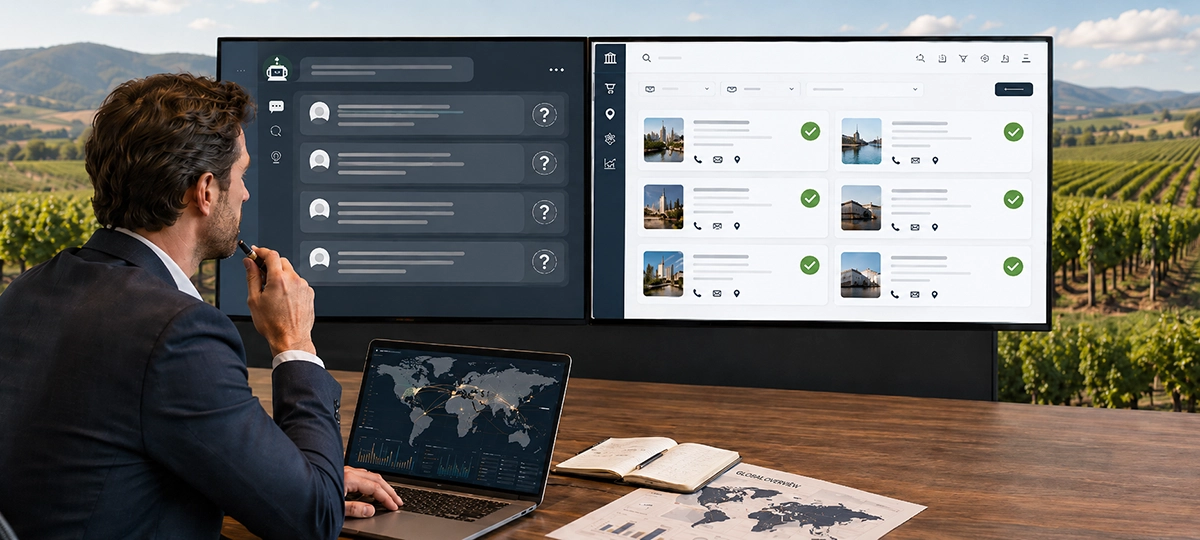
Finding wine importers has traditionally required hours of online research, trade-fair visits, industry introductions and manual checking.
Generative AI promises a faster alternative. A winery can now ask ChatGPT to: “Find 30 wine importers in Germany that distribute premium French red wines and work with independent retailers.” Within seconds, it may receive a structured list of companies, websites and descriptions.
That is considerably faster than searching Google one company at a time. But does the resulting list contain buyers a winery can actually contact?
The answer is more nuanced than either “AI can do everything” or “AI-generated data cannot be trusted.”
ChatGPT can be a good export-research assistant but it is much less reliable as the final source of record for company status, importer activity, portfolio fit and buyer contact information.
What ChatGPT can do well
When used correctly, ChatGPT can accelerate several parts of the prospecting process.
1. Identify possible companies
AI can quickly surface companies publicly associated with wine importing and distribution.
In current searches, for example, it can identify established businesses such as Liberty Wines, Hallgarten & Novum Wines, Winebow and Skurnik. Their official websites confirm that they operate as wine importers, distributors or both.
This makes AI useful for initial market exploration.
2. Organize public information
ChatGPT can summarize information found across:
- Company websites
- Producer portfolio pages
- News announcements
- Trade-fair catalogues
- Interviews
- Distributor profiles
- Public business directories
ChatGPT Search can also search the web and provide source citations, allowing users to inspect the pages behind an answer.
3. Help define a target buyer
Before looking for company names, a producer can use AI to clarify what an appropriate importer might look like for your company
For example:
- Country or region covered
- On-trade versus retail focus
- Premium versus volume positioning
- Existing countries of origin
- Organic or natural-wine specialization
- Portfolio size
- Distribution model
- Customer types
- Whether the importer already represents competing products
This strategic work is often more valuable than simply generating a long list.
4. Support personalized outreach
Once a company has been properly verified, AI can help a producer analyze its portfolio and prepare a more relevant introduction.
It can suggest:
- Which products from the winery’s range may fit
- What portfolio gap might be addressed
- Which aspects of the winery to emphasize
- How to shorten an introductory email
- What questions to ask during a first meeting
The important phrase is once the company has been properly verified.
A company name is not yet a qualified lead
The biggest weakness of AI-generated lists is not necessarily that every company is false.
Many of the businesses may be real.
The problem is that a real company can still be an unusable prospect.
A commercially useful importer lead requires answers to several additional questions:
- Is the company still active?
- Is it currently importing wine?
- Which markets and channels does it serve?
- Does its portfolio fit the producer’s product?
- Has the company changed its name or ownership?
- Is it part of a larger group?
- Who makes purchasing decisions?
- Is the available contact information current?
- Is there evidence of recent buying or shipment activity?
AI may answer some of these questions, but it cannot be assumed to answer all of them correctly.
OpenAI itself advises users to verify important information because ChatGPT can produce inaccurate statements, fabricated references or confident answers that are not fully supported by evidence.
What our accuracy check revealed
Rather than judging an AI list solely by whether the company names existed, we examined the elements that determine whether those names could be used in a real export campaign.
Several recurring problems appeared.
Problem 1: The information may be correct but outdated
Company data changes continuously.
Importers are acquired. Teams change. Portfolios move. Brands are renamed. Businesses enter or leave markets.
For example, Enotria & Coe announced a rebrand to Enotria in September 2025. An AI answer using the older company name might still point to the right organization, but it would already be commercially dated.
A more significant example occurred in July 2026, when New Generation Wines acquired Bancroft Wines, with integration planned in phases through January 2027. A static list could continue presenting the two businesses as completely separate prospects without explaining their new relationship.
That distinction matters. Contacting several companies that now belong to the same organization can create duplicated outreach and an unprofessional impression.
Problem 2: “Importer” can mean several different things
Wine businesses do not always fit neatly into one category.
A company may be:
- An importer
- A national distributor
- A regional wholesaler
- An agent
- A retailer
- An online merchant
- A restaurant supplier
- A brand owner
- Several of these at the same time
Les Caves de Pyrène, for example, describes operations spanning importing, distribution and retail. Other companies combine exclusive agency agreements with wholesale distribution or direct-to-consumer sales.
An AI-generated list may classify all these companies as “wine importers” without explaining whether their commercial model fits the producer.
A winery searching for a national distributor needs a different partner from one looking for a niche natural-wine specialist or a private-label retail buyer.
Problem 3: A public portfolio does not prove current buying intent
A company website may show that an importer handles Italian wine, sparkling wine or organic products.
That does not tell the producer:
- Whether the portfolio page is current
- Whether the buyer is looking for another supplier
- Whether the category is already overcrowded
- Whether the importer is increasing or reducing activity
- Whether the company buys directly
- Whether it is currently receiving shipments
- Whether the producer’s price level fits its customers
The website can confirm broad relevance, but not necessarily current opportunity.
Shipment and trade data can add another layer by showing whether a company has been actively importing, where it sources products and how frequently activity appears. BestWineImporters’ Trade Data module is designed to help users distinguish businesses with observable shipment activity from companies that only appear relevant based on public descriptions.
Problem 4: AI often stops at the generic company address
Even when ChatGPT finds the right business, it may return:
- An
info@address - A contact form
- A general telephone number
- An old employee
- A founder who no longer handles buying
- A LinkedIn profile without contact information
For export outreach, the difference between a generic inbox and a relevant decision-maker can be decisive.
Depending on the company, the appropriate person might be:
- Wine buyer
- Purchasing director
- Portfolio director
- Head of buying
- Managing director
- Category manager
- Brand manager
- Import manager
The correct role also depends on the size and structure of the organization.
Problem 5: The list may contain companies that are real but poorly matched
Suppose a small winery produces 20,000 bottles per year of premium biodynamic wine with a cellar-door price equivalent to €15.
A large national distributor may be a genuine importer, but still be unsuitable because it expects:
- Higher production capacity
- National marketing support
- Lower pricing
- Proven sales volumes
- Established brand awareness
- A broader range
- Exclusive market rights
Meanwhile, a smaller specialist importer serving independent retailers and premium restaurants may be a much stronger prospect.
AI can suggest both companies. It may not reliably rank them according to the winery’s commercial reality.
A better way to use ChatGPT for importer research
The most effective approach is not to choose between AI and a verified database.
It is to use each tool for the task it performs best.
Step 1: Define your ideal importer
Start with your own commercial constraints:
- Wine type
- Country of origin
- Certifications
- Ex-cellar price
- Expected retail price
- Annual production
- Available export volume
- Current markets
- Target countries
- Preferred sales channels
- Marketing support
- Exclusivity expectations
Without these details, even a perfectly accurate importer list will be too broad.
Step 2: Use AI to develop market hypotheses
Ask ChatGPT questions such as:
- Which European markets have developed specialist retail channels for premium organic wine?
- What importer types are most suitable for a winery producing fewer than 30,000 bottles annually?
- Which questions should we ask before appointing an exclusive distributor?
- What portfolio characteristics would indicate a good fit for our winery?
At this stage, AI helps structure the research.
Step 3: Find the relevant buyer using BestWineImporters
Only after confirming company fit should you identify the person responsible for the category.
BestWineImporters currently provides access to more than 35,000 verified wine importers, distributors and retailers across 168 countries. The platform’s records are checked and updated continuously, with buyer contacts available in more than 70% of company profiles. The verification process is also done by trained, experienced data analysts that only focus on the beverage sector.
Step 4: Use AI again for preparation and outreach
Once the underlying information is reliable, ChatGPT becomes valuable again.
Provide it with:
- The importer’s verified profile
- Relevant portfolio information
- The buyer’s role
- Your winery presentation
- Your target product
- The reason you believe there is a match
Ask it to help prepare a concise, personalized email that refers only to facts you have verified.
Can ChatGPT replace a wine importer database?
No, because the two tools solve different problems.
ChatGPT is primarily useful for:
- Understanding markets
- Organizing research
- Generating hypotheses
- Summarizing public information
- Preparing communication
- Improving productivity
A specialized database is useful for:
- Filtering a defined buyer universe
- Accessing structured company profiles
- Finding decision-maker contacts
- Checking company categories
- Reviewing trade or shipment information
- Building export lists at scale
- Tracking updates consistently
AI can make a database more useful. A verified database can make AI output safer and more commercially actionable.
Can ChatGPT provide wine importer email addresses?
It may find email addresses that are already publicly visible. However, there are three risks:
- The email may no longer be valid.
- It may belong to the wrong employee.
- It may be a generic address with little chance of reaching the buyer.
The number of email addresses provided can be very small so the process can be very time consuming using AI.
Any contact should be verified before outreach, and the communication must comply with the applicable privacy and electronic-marketing rules in the sender’s and recipient’s jurisdictions.
The most important conclusion
ChatGPT can be useful for researching markets, refining outreach messages and generating initial ideas, but it is not designed to build a large, reliable prospecting list.
BestWineImporters remains the stronger tool for this task because it gives exporters access to thousands of verified wine importers, distributors and buyers, together with decision-maker contacts, company details, filters and trade information. Instead of checking companies one by one and wondering whether the data is current, producers can quickly create a focused outreach list based on their target markets, product type and commercial priorities.